


“Let’s try it:” how an R&D mindset can lead, years later, to patented discoveries
1. DIRECT AIR CAPTURE IS AN R&D ZONE — AND THIS IS PUSHING INNOVATION FORWARD
“Research and development” is happening at so many levels in direct air capture that R&D may be the best way to understand the state of the industry as a whole. While some DAC methods are more proven and more deployed than others, all of them — excitingly — are evolving. This makes R&D a central part of Airhive’s business rather than a nice-to-have activity on the side.
We’re researching and developing all the time. We test configurations and operating parameters to improve the DAC system in place. But, we also run experiments that could lead to a next-generation Airhive DAC system.
Sometimes tests of the current system give us a breakthrough that points to a next-gen system — and we were lucky to have such a breakthrough a few months ago. It involved a fairly minor input, but it has the potential to make our whole DAC process more efficient. So much so that we’ve filed a patent for it.
The breakthrough involves our mineral sorbent: the little rocks that geochemically help capture CO2 in our system. We knew that improving our calcium-based sorbent even a little bit could lead to big results. If the reaction happens faster and/or with lower energy requirements, operational and capital costs would fall. DAC upfront costs and pricing would also fall, making the entire technology more accessible.
My team and I tested hundreds of different sorbent combinations for three years, led by our Sorbent Lead, Dr. Hipassia Moura. Most of them failed. Our success started with a hypothesis inspired by nature. We observed that mixing limestone (which is calcium-based) with another elemental compound found abundantly in nature (and that we can’t discuss here because of the patent) could enhance limestone’s properties when applied to processes similar to DAC.
We then zigged and zagged our way to an unusual hypothesis: that a different natural additive could enhance limestone’s properties even more efficiently because of its similarities with the first elemental compound we observed. Ideas then progressed to experiments and dosages. We found that mixing our calcium-based sorbent with small amounts of the other natural additive led to a full 50% more CO2 captured. When applied to a 1,000-tonne system like our new one at Deep Sky Alpha, or the 10,000-tonne system we are planning for 2027, these gains make a big difference.
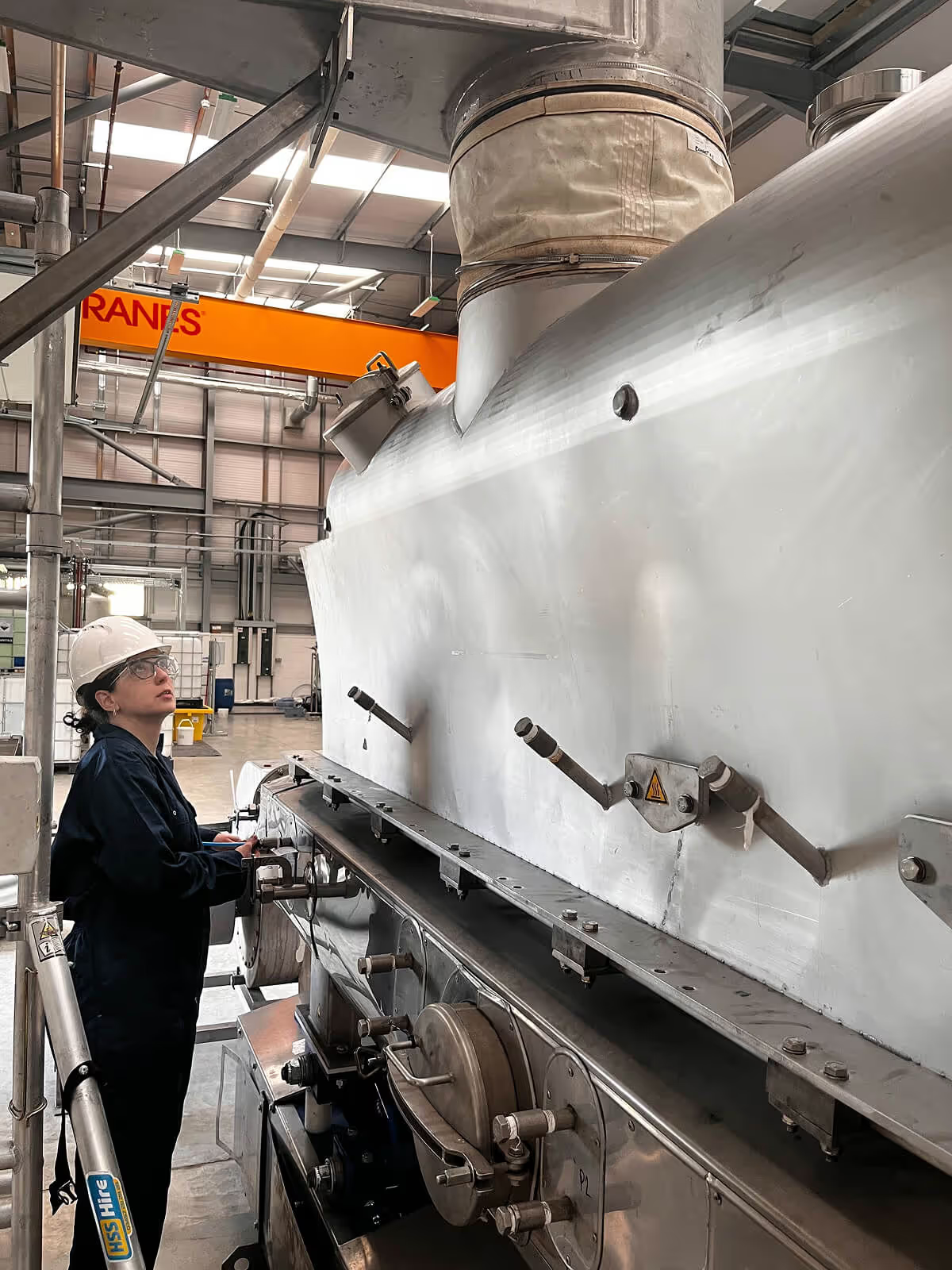
So a higher performing DAC system is now within view. It’s based purely on swapping a sorbent ingredient. We’re running more tests, including at our Tenet pilot plant in Teesside, UK, to see how far we can push the efficiency gains from this geochemical reaction. Tenet is a small-scale but fully integrated system: the perfect test bed. These tests may catalyse a new set of experiments that leads to discoveries unrelated to sorbents.
2. AIRHIVE’S R&D METHOD: RAPID, FOCUSED TESTING — WITH SPACE FOR BLUE-SKY THINKING
Constant testing is essential for developing any new technology. But its importance is probably greatest for climate technologies like DAC that could — and must — help lower our planetary thermostat.
Our approach is a little unusual even compared to other hardtech or climate tech startups. It blends focused, commercially minded tests with more open-ended experimentation. Developing a complex but low-cost DAC system - and quickly - requires this kind of fusion of theory with practice, of ideas with their application.
In our daily work there is a natural interplay between a) experimenting with ideas that might lead to better systems and b) building systems that sharpen our understanding of what really works in the field. Only when we try our new sorbent at industrial scale will we fully appreciate its properties; yet we might not build such a large industrial unit without this specific R&D breakthrough.
The balance of rapid, rigorous experimentation and blue-sky thinking plays out over long periods of time. It might take a few years to see how they fuse to deliver a discovery. The two approaches are not balanced, strictly speaking: most of the time is spent on the more pragmatic, targeted experiments that could help our operations in the short term.
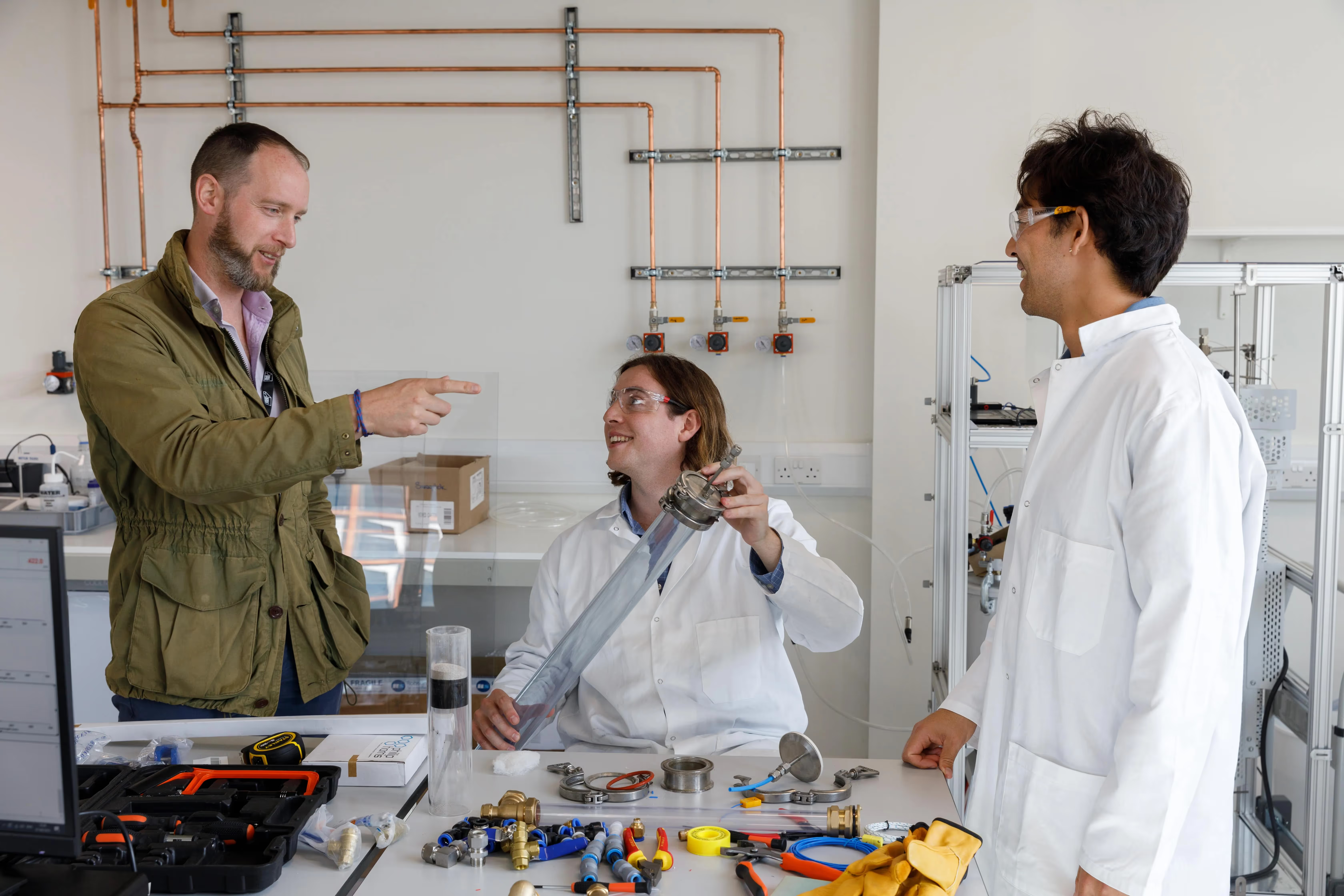
Carving out time for creative thinking, however, is just as important as the tests that follow it. I can trace our sorbent breakthrough to a “let’s try it” policy that we started in our London lab a few years ago. Anyone on the team could write a one-page proposal for something they’d like to test, even if the proposal was a hand-drawn diagram. No idea was too crazy. On Thursday afternoons we would play some music in the lab and try some of them out … hoping they would lead to something like the patent application we just filed.
Filing for a patent is thrilling, but it is also a reminder of the hundreds of failed attempts that led to the eventual breakthrough. There will be many more experiments and probably many more setbacks before we file our next one.
As a scientist I know how tempting it is to think about R&D in a linear way: a certain input neatly changes the trajectory towards an outcome. I think R&D is more like surfing; getting wiped out is part of the fun. Catching a wave requires tireless paddling, your eyes on the ocean, and a little splash of fortune.
.avif)
