


“DAC is too expensive” misses the point: It is better value than many industrial decarbonisation methods, all of which we need
Decarbonisation is hard, as we know from the term “hard to abate emissions.”
Also expensive, at least for now. Green steel is up to 140% more expensive than conventional steel, which already costs $700-800 per tonne if it’s made in Western Europe (IEA). Sustainable Aviation Fuel is over $2,600 per metric tonne, versus conventional jet fuel around $1,200.
Direct Air Capture (DAC) today is priced at $500–$1,025 per tonne of CO2 removed, making it one of the more costly removal methods compared to:
- biochar carbon removal at $94-500 (ClimeFi)
- forestry-based carbon removal at $15-45 (today’s spot markets)
DAC is expensive, yes. But calling it “too expensive,” a claim often levelled against DAC, is wrong on a few fronts – in terms of absolute value, relative value, and future costs:
- Absolute value: DAC cleans up carbon dioxide pollution from the atmosphere and makes the planet more liveable, delivering on societal goals. Its premium relates to its high permanence – the CO2 is stored for 10,000+ years – and high verifiability.
- Relative value: DAC in many cases will be cheaper on a net tonne basis than other industrial decarbonisation methods. We need all of these solutions from DAC to biochar to SAF to green steel – these and more. But assuming that premium, engineered carbon removal is the most expensive is incorrect.
- Future costs: Costs will fall in the future, especially as regulation and compliance incentivises large-scale investment. Cost curves seen in other technologies will play out in DAC – and across industrial decarbonisation.
Cost is always relative to value, whether we’re talking about a ‘green premium’ or a luxury goods premium. DAC’s value is maybe more definable than for luxury goods:
⇒ Value is delivering decarbonisation at a scale that mitigates climate change – and doing it as cost-effectively as possible over the long term
⇒ Achieving that value depends on deliverability
⇒ deliverability depends to a large extent on capital allocation through finance
Looking ahead to 2030, I think we need to move on from questions like “Is DAC too expensive?” to other such as:
- How do all-in DAC costs compare to other decarbonisation methods when considering the entire value chain?
- Is the project financeable?
- Where does DAC have government support to help it scale?
1. HOW DO DAC COSTS COMPARE TO OTHER DECARBONISATION METHODS WHEN CONSIDERING THE ENTIRE VALUE CHAIN?
A common misconception is that thermodynamics - specifically the “entropic penalty” - disadvantages DAC by raising energy costs higher than other decarbonisation methods. The thinking goes: CO2 is spread thinly through the atmosphere, a large amount of expensive energy is required to power the machines that capture and separate it from the air, and that process (for its fixed costs) can never be fully efficient either thermodynamically or financially.
I won’t go into the ways that DAC’s capture and separation processes are becoming more energy-efficient. The bigger point is:
entropy doesn’t drive the cost base for DAC as much as the market thinks
Carbon capture and storage (CCS) technologies all deal with entropic penalties on energy efficiency. But it’s a minor cost factor compared to the price and availability of clean energy for regeneration. DAC and CCS, like green hydrogen and other industrial decarbonisation methods, are energy-intensive. The energy must be renewable or from waste to fulfill the low-carbon goal. For DAC, clean power drives the cost base, along with EPC costs and the cost of capital. There is very limited structural burden on DAC costs from entropic penalties.
We need to look at all-in costs for decarbonisation methods across their entire value chain and then compare them method by method. We might find that if DAC is not the Lamborghini of decarbonisation technologies, but rather a BMW that’s relatively cost-competitive and more in demand than people think right now.
Consider decarbonised steel or cement. Both of these require refitting and rebuilding current industrial facilities and to an extent reinventing current industrial processes. Energy and other inputs must change along with manufacturing methods, while the product must be the same or better.
Although a granular cost analysis is not the purpose of this blog, it’s fair to say that DAC is cost-competitive when considering end-to-end abatement costs for many forms of industrial decarbonisation.
This is because:
DAC is a self-contained carbon removal method versus a multi-stage industrial transformation.
Fully decarbonising shipping will require new methanol and ammonia fuels and new ship engines. Low-carbon aviation will require not only new fuels but eventually new jets. SAF prices, in this sense, are a misleading indicator of the true cost per tonne of decarbonising flight emissions (a point recognised by the CORSIA scheme, which facilitates carbon offsetting across the industry). Decarbonising the ambient air, on the other hand, requires a modular DAC unit and a carbon storage site; the cost will be the market price of DAC.
To be clear, we need all of these solutions, even if right now they can be called “too expensive.” One is not better than the other. But some have cost and other advantages.
One of DAC’s advantages is that it can help legacy industries decarbonise:
- DAC can capture and store CO2 anywhere and can be decoupled from real infrastructure - unlike green cement or green steel, for example.
- It can be embedded in industrial facilities to augment their decarbonisation methods. They can be placed in chemicals plants, food and beverage factories, data centres, or really anywhere.
- If the removal is stringently verified, it can also substitute for emissions reductions in hard-to-abate industries more cost-effectively than fully decarbonising those industries. This is the insight behind recent policy proposals, including the Whitehead Report in the UK and Oxford Net Zero’s Certifying Geologically Balanced Fuels, which call for DAC to augment SAF to achieve aviation decarbonisation.
“Too expensive” is doubly misleading when you consider DAC’s role in reducing end-to-end decarbonisation costs for other industries by permanently removing the emissions those industries caused in the first place.
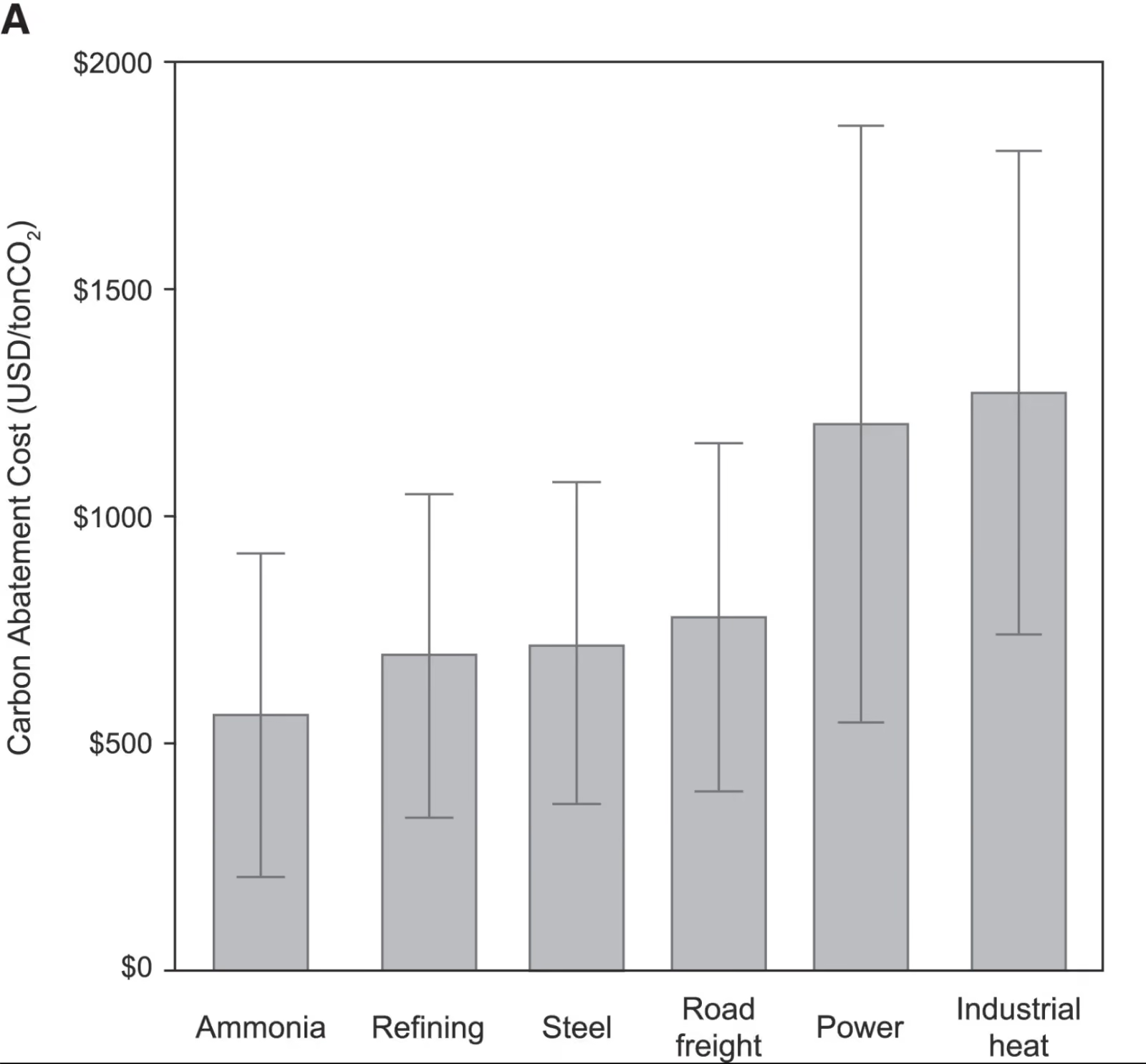
Carbon abatement cost of green hydrogen used across six industries, at 2024 delivered prices
2. IS THE PROJECT FINANCEABLE?
As more DAC methods prove themselves at the pilot stage, we need to shift the question from “Is it expensive?” to “Is it financeable?” If the second question is a yes, the first question is not too relevant.
DAC projects worth financing now will play a role in lowering DAC’s cost profile over the long term. The more the technology is built out, the lower the average costs of DAC. Getting to sub-$300 DAC in ten years depends on buildout today. Buildout is capital-intensive and needs financing.
We have to be brutally honest as an industry: half or more of DAC projects today may not be financeable. We trust Airhive’s are, but no developer can be certain.
What does “getting financed” require? Quite a lot of factors, but let’s start with one that sometimes is overemphasised. The DAC technology design itself, including its embedded costs from energy and other inputs, is a prerequisite to even be considered. More determinative factors are:
- upfront capital requirements: for example if a company is asking to build a 100,000 tonne plant or a 10,000 tonne modular DAC unit that, if successful, could be replicated 10 times
- government policies: the UK’s Greenhouse Gas Removal Business Model and Canada’s Investment Tax Credits for DAC act almost like financial backstops, improving bankability. More on that below.
Here are a few projects that have been financed recently:
- Avnos, Project Cedar: Shell Gas & Power and Mitsubishi Corp funded up to $17m for a phased buildout of DAC modules.
- OnePointFive (an Oxy subsidiary), Stratos: financed off the balance sheet of its parent company. This Texas-based DAC facility will be the world’s largest when it opens in the next two months.
- Heirloom, all DAC projects: Development Bank of Japan added more (undisclosed) funding to US-based Heirloom’s earlier $150 million Series B, which was anchored by other Japanese companies like Japan Airlines, Mitsubishi Corp, and Mitsui & Co. The funds will build Heirloom's DAC plants in the US.
The most financeable projects through 2030, in my view, will have strong market support for deploying CO2 to the carbon markets and-or industry. CO2 captured directly from the atmosphere and stored for 10,000+ years can earn developers $500+ per tonne from premium carbon credits. But it can also be sold to provide a secure supply of high-quality, green CO2 – an alternative to conventional carbon dioxide derived from fossil fuels.
Whether the CO2 is sold as a net zero instrument, an industrial commodity – or ideally with potential for both end-markets – bankable projects need revenue certainty.
3. WHERE DOES DAC HAVE GOVERNMENT SUPPORT TO HELP IT SCALE?
Government support is shaping up to be a key factor shaping whether a DAC project is financed and ultimately built.
It will become more important through 2030 as high capital costs for scaling DAC intersect with national decarbonisation goals, strengthening the role of government in facilitating a private-sector-led transition.
Government support shows up in different ways. The EU, UK and Japan are including carbon removal in their emissions trading systems from now through 2030; the EU alone has committed to buying 250 million tonnes of carbon removal in the 2030s. Canada and other countries use tax incentives to soften capital expenditure costs.
The result of this support – even if it happens at different speeds – will be lower average DAC prices, sooner.
As AP Ventures explains in a great post, the story of catalytic converters in the US shows how a little regulation can transform a technology from “too expensive” to commonplace. In the 1970s catalytic conversion, which cleans exhaust from automobile engines, was proven at small scale but distrusted in part because of its high costs. But costs could not fall until there was mass adoption, driven by compliance.
The Clean Air Act targeted tailpipe emissions. Catalytic converters were one, though not the only, way to meet the law. Demand surged, and the cost curve fell steeply. DAC in 2027 is roughly where catalytic conversion was in the years before the Clean Air Act. Instead of from the US, regulatory incentives this time will come from the EU.
OTHER QUESTIONS?
This discussion can seem abstract, but it’s not for us at Airhive. We’re working to deliver DAC at sub-$500 per tonne by 2028 and sub-$200 in the long term. That depends on financing the scale-up of our systems, partly through government support and partly through private capital that sees the benefits of our method alongside other industrial decarbonisation solutions.
Is it expensive now? Yes, maybe, though it’s relative to how you view its value.
Will it be expensive forever? No.
Is it the most expensive industrial decarbonisation method? Not at all, especially when you look at end-to-end costs.
The most important questions for DAC are not about today’s costs, expense, or whether DAC will happen at all as a result of expensive costs. Common to all industrial decarbonisation methods, the real questions are about how to incentivise its buildout at scale: how do we build DAC safely, at a scale that matters to climate change, starting as soon as possible, so that costs can fall and adoption can rise?
